 Connect with a Marketing Expert


Here is a scenario every home service marketer will recognize soon, if they haven't already.
An HVAC company in Dallas, Texas asks ChatGPT, "Who's the best emergency AC repair company near me?" The owner runs the same prompt, pops open a fan-out tracing tool, and watches ChatGPT quietly fetch his website in the background. He sees his own domain in the trace. He assumes he has won AI search.
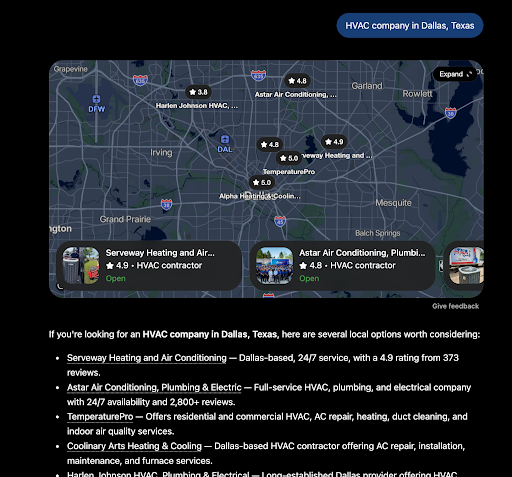
Then he reads the actual answer. His company is nowhere in it. ChatGPT recommends three other shops instead.
That gap, between being read and being recommended, is the single most misunderstood thing in AI search right now. And it is costing home service businesses real jobs, because most operators (and a lot of agencies) are optimizing for the wrong half of the problem.
The truth is that AI visibility is not one funnel. It is two. Getting your pages pulled into ChatGPT's background searches is funnel one. Getting one of those pages to actually surface in the answer with your name on it is funnel two. They are separate contests with separate winners, and if you don't know which one you're losing, you can't fix it.
Let's break down both, why home services is uniquely exposed at each stage, and what to actually do about it if you run a trades business in Texas, Florida, or Alabama, or an agency serving them.
The Two Words You Have to Stop Using Interchangeably
Start with vocabulary, because this is where most of the confusion lives.
Retrieved means a page ChatGPT fetched while running its background searches. Cited means a page that made it into the visible answer as a clickable source. These are not the same event, and right now they are moving in opposite directions.
The number of pages ChatGPT retrieves per response is climbing. But the number of unique domains it actually cites per response is falling. Analysis from the Resoneo team, who have done some of the deepest reverse-engineering of ChatGPT's retrieval architecture, found the unique domains cited per response dropped from 19 to 15 after one model update. More pages get considered, fewer pages get credited.
How wide is that gap? In a network-traffic study by Suganthan Mohanadasan, only about 110 of 3,554 retrieved pages, roughly 3.1%, made it into an answer at all. Read that again. For every hundred pages ChatGPT pulls in the background, about three survive into the response a user actually sees.
So here is the model that should reframe how you think about AI search:
- Funnel one is retrieval. Getting read. This is a ranking and indexing problem.
- Funnel two is the retrieval-to-citation conversion. Getting recommended. This is an authority, clarity, and first-party-data problem.
Almost every "how to show up in ChatGPT" article you have read collapses these two into one and then hands you tactics for whichever one the author happened to be thinking about. That is why the advice feels scattered and why results are inconsistent. You cannot fix a funnel-two problem with funnel-one tactics, or the reverse.
Why Home Services Get Hit Hard at Both Stages
This two-funnel squeeze hits everyone, but local trades businesses are structurally more exposed than most. Three reasons.
First, your industry lives on the exact page types AI search is de-prioritizing. For years, a plumber's "online presence" was scattered across Angi, Yelp, Thumbtack, and an endless supply of "10 Best Plumbers in Tampa" listicles. Those roundup and directory formats are precisely the content losing retrieval share. According to Peec AI's analysis, product pages have climbed to 16.39% of retrieved pages, moving ahead of listicles, and the formats bleeding share (listicles, how-to guides, comparison pages) are the ones most heavily spammed for AI optimization over the past two years. If most of your visibility was borrowed from directory listicles, the ground is shifting under you.
Second, the model's routing logic can shut a thin local site out of both paths. ChatGPT routes different questions to different kinds of sources: facts go to official and brand-owned pages, while opinions go to reviews and Reddit. So for "is Reliant Plumbing licensed and insured in Austin," the model wants an authoritative or first-party answer. For "best plumber in Austin," it wants community sentiment and review platforms. A generic contractor website with no crawlable facts and no real review footprint fails both the fact route and the opinion route.
Third, and this is the big one, ChatGPT often decides who it's going to recommend before it finishes searching. Suganthan's research found that 21 of 27 initial queries contained brand names the user never typed, across 11 of 13 product categories. When he searched "the best AI note-taking app," the very first background query already named Granola, Notion AI, Otter, Fireflies, and several others. The model walked in with a shortlist.
Now apply that to trades. In home services, the names the model tends to walk in already knowing are national franchises like Roto-Rooter, Mr. Rooter, and One Hour Heating and Air, plus the big aggregators. If you are the independent two-truck HVAC shop in Mobile, Alabama, you are very likely not in that prior. And being in that first query matters enormously: Suganthan found that brands named in the fan-out were cited 68.9% of the time, while pages that were only fetched were cited 2.1% of the time. Getting named up front is worth roughly 30x more than getting quietly fetched.
Funnel One: Getting Retrieved Is Still a Ranking Problem
Here is the part the "SEO is dead" crowd keeps missing. ChatGPT's background searches are run against a search index. ChatGPT search has historically run on Bing through the Microsoft partnership, and independent testing suggests it also pulls from Google's index, possibly through third-party scrapers, on top of OpenAI increasingly building its own index. Whichever engine logs the retrieval, the mechanic is the same: if you don't rank for the specific background query the model generates, you are not in the retrieval set. Full stop.
And those background queries are getting more numerous and more precise. When one recent model became the default, Peec AI found the share of prompts using only a single background query dropped from 94.0% to 43.5%, and average retrieved sources roughly doubled. A separate study from Chris Long at Nectiv found average background queries per prompt jumped from 2.17 to 7.61, with the longest query chain running all the way to 29 searches.
More background queries mean more specific sub-queries. For a Jacksonville roofer, the model isn't just searching "roofer Jacksonville." It's generating things like "emergency roof leak repair Jacksonville FL," "storm damage roof replacement Duval County," and "licensed roofing contractor Jacksonville financing." Each of those is a ranking contest. Miss the ranking, miss the retrieval.
One more critical shift: the site: search operator has exploded inside these background queries. Peec AI measured it going from roughly 0.3% of fan-outs to about 23%, and Nectiv measured it at as much as 64% of queries. The model is increasingly scoping its searches to specific domains it already trusts. For a local business, that means two jobs: rank for the open city-and-service queries, and become a domain the model will scope a site: search to in the first place.
What to actually do for funnel one:
- Aggregate the background queries, then track the clusters, not the strings. Use a fan-out tracing tool to capture the sub-queries ChatGPT repeatedly runs for your services and cities, distill them into core keyword clusters, and rank-track those across both Google and Bing. Bing matters far more than its market share suggests here because of the OpenAI relationship.
- Do not build hundreds of thin pages to chase individual long-tail fan-outs. This is a trap. Mass-producing near-identical long-tail pages is exactly what Google's scaled content abuse policy is built to catch, and it will torch your rankings, which torches your retrieval. Build genuinely useful service and city pages that earn rankings honestly.
- Get into Bing Webmaster Tools now. In February 2026, Bing launched an AI Performance Report inside Webmaster Tools that separates AI citations from traditional search and surfaces "grounding queries," the internal sub-queries the AI generates to retrieve content. Google still hides this. Bing hands it to you.
Funnel Two: Converting Retrieval Into Citation Is Where Local Businesses Win or Lose
This is the section almost nobody writes for home services, and it is where the jobs are actually won. Once you're retrieved, what earns the citation?
Machine-readable first-party facts on your own domain. Remember, facts route to the brand's own site, and the model runs site:yourcompany.com searches looking for them.
That means your license number, service area, "24/7 emergency" availability, dispatch or trip fees, financing options, brands you service, and warranty terms all need to sit in plain, crawlable HTML text. Not baked into a hero image. Not locked inside a JavaScript widget that renders after load. If ChatGPT scopes a search to your domain looking for whether you serve Fort Worth or offer financing and it cannot read the answer, you lose the citation to a competitor whose site says so in plain text. For most contractor websites, this is the single highest-leverage fix available, and it is almost always a five-figure blind spot hiding in a pretty but unreadable design.
State your claims clearly and early on the page. Bury "we've been serving Huntsville since 2004, licensed and insured, same-day service" three scrolls down inside a paragraph of fluff and you make the model work to extract it. Put it up top, in clean text, and you make yourself easy to cite.
Lock down which domain is officially yours. This is a genuine, and genuinely underrated, risk for smaller trades brands. The word "official" is climbing as a top term in fan-out queries because the model is actively hunting for a brand's verified source. The problem is that when the model is unsure of the correct domain, it guesses, and it sometimes guesses wrong. Malte Landwehr documented cases where ChatGPT built site: queries against a domain that didn't belong to the company at all, in one case pointing at a parked domain that was available to buy. A Netcraft study found roughly a third of brand login links generated by LLMs pointed to domains the brand didn't own, with about 29% pointing to unregistered, inactive, or parked domains, and smaller brands the most exposed.
Translate that to a home services reality. Say there's a "Summit Comfort Heating and Air" in Pensacola with a weakly established domain. ChatGPT could scope its trusted search to the wrong summit-comfort URL, or worse, to a parked domain that a competitor or a scammer buys, fills with matching content, and seeds with a fake phone number. Your defense is boring but essential: pick one official domain, reinforce it relentlessly with consistent name, address, and phone across every listing, and use "Official Site" language in your title tag or meta description where it reads naturally and honestly. For a small brand, this is the best protection you have against being impersonated in the exact channel your customers now trust.
Treat reviews and Reddit as category perception, not a citation guarantee. For opinion-driven queries like "best drain cleaning company in Orlando," the model leans on review platforms and specific subreddits like r/HVAC, r/Plumbing, and local city subs. But be clear-eyed about how this actually works. Dan Petrovic found ChatGPT discards the Reddit pages it retrieves roughly 99% of the time. And yet Reddit still tops Ahrefs' most-cited-domains list, because it gets retrieved so relentlessly that even a 1% survival rate produces more citations than almost anyone else in absolute terms. So Reddit shapes how the model understands your local market more than it reliably sends a citation your way. Show up authentically in those conversations, but do not treat them as a dependable path to being named.
And a hard warning here, because bad advice is everywhere: do not astroturf Reddit with fake recommendations of your own business. Reddit has cracked down on exactly this kind of AI-visibility spam, using its own systems to flag around 25,000 spammy posts and comments per day. Get caught, and your account is gone, along with any trust you built.
Diagnose Which Funnel You're Actually Losing
The beauty of the two-funnel model is that it turns a vague worry ("are we in ChatGPT?") into a specific diagnosis. Here's how to run it.
Take the prompts that matter for your business. For a San Antonio electrician, that's things like "best electrician in San Antonio," "emergency electrical repair near me," and "[your company name] reviews." Run each one about five separate times, and watch the fan-out trace, not just the final answer. Record whether your brand appears in the model's initial background searches.
- If your brand never appears in the background queries at all, you have a funnel-one problem. You're not being retrieved, and you're not in the model's prior. The fix is rankings and brand-building over time: reviews, local PR, media coverage, and genuine authority. Technical tweaks alone won't save you.
- If your brand gets retrieved but never cited, you have a funnel-two problem. You're getting read and losing the recommendation. The fix is first-party crawlable facts, clear early claims, and locking down your official domain.
Two funnels, two diagnoses, two completely different action plans. That single test tells you where to spend.
While you're in the tools, check one more thing. Look at your Google Search Console and Bing Webmaster Tools query reports for site: searches against your domain. When Lily Ray looked at this across major brands, she found site: queries generating thousands of impressions with almost zero clicks, in one case around 197,000 impressions and a single click. A click-through rate that close to zero isn't human. It's bots and LLMs pulling your brand into their retrieval process. For a local business, that pattern is a rough signal that something is scraping searches to your domain, which is worth knowing even if the data is noisy.
The Playbook, Prioritized for a Real Trades Budget
Pulling it together into an ordered plan, tagged by funnel so you're never guessing which problem you're solving:
- (Funnel 1) Rank for the real service-and-city sub-queries the model generates, across both Google and Bing. Distill fan-outs into core clusters instead of chasing individual strings.
- (Funnel 2) Put your license number, service area, emergency availability, pricing structure, financing, and warranties in plain, crawlable HTML on your own domain.
- (Both) Lock down your official domain and reinforce it everywhere. This is the biggest small-brand vulnerability and the cheapest to fix.
- (Funnel 2) Build legitimate review depth and community presence through your Google Business Profile, real review platforms, and honest participation. No astroturfing, ever.
- (Measurement) Run the five-times fan-out diagnostic every quarter, and watch
site:impressions in Search Console and Bing Webmaster Tools.
The Reframe Worth Keeping
AI search didn't kill SEO. It split it into two funnels, and rankings feed both. Rankings get your pages retrieved. The authority and brand equity that ranking reflects are a big part of what gets those pages cited. The home service businesses that win the next few years will treat their own domain as the source of truth and their rankings as the delivery system, while the listicle-and-directory era that used to carry mediocre contractors quietly loses its retrieval share.
So stop asking whether you're in ChatGPT. Start asking which funnel you're losing. That's the question that actually has an answer, and a fix.