 Connect with a Marketing Expert

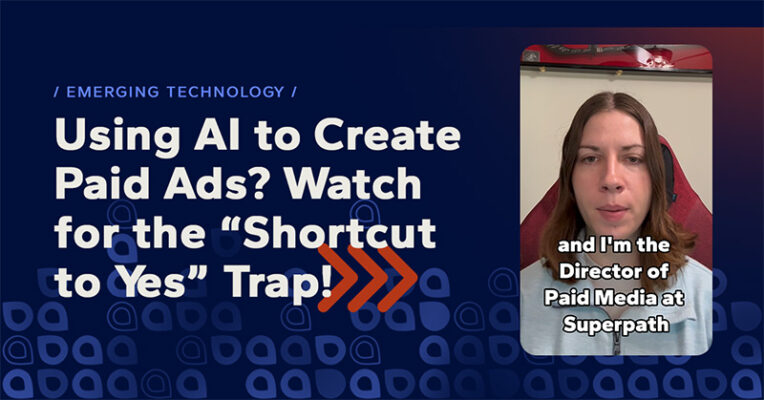
A post shared by Superpath (@superpathmarketing)
Below is the transcript from the video above, lightly edited for readability and context.
I'm Katrina Matter, and I'm the Director of Paid Media here at Superpath. I wanna talk about why you need to be careful when using AI tools like ChatGPT, Gemini, and Claude to help you when researching your paid campaigns.
These tools can be great, but you need to stop viewing them as an all-knowing marketing teacher. In reality, they can be confident liars. They wanna tell you exactly what they think you wanna hear, which can sometimes lead to confidently delivered but completely inaccurate information.
The “Shortcut to YES” Trap in Paid Search
Recently, we had a client who used an AI tool to help them build a paid search strategy that would deliver them a certain number of leads. In their prompt, they had mentioned their lead goal as well as their high closing rate. And the AI, wanting to be helpful, came up with a strategy that used that high closing rate as the campaign's conversion rate.
It told the client they only needed a small budget because, in its digital mind, nearly every person who clicked on the ad would instantly become a lead.
In the real world, those numbers were unrealistic. The AI didn't come up with a brilliant strategy. It confused how well the company closes someone who calls them with how difficult it can be to get that person to call in the first place.
That math error happened because the AI was looking for a “Shortcut to YES,” and it didn't check out what an average conversion rate in that industry is for a paid search campaign.
How AI Can Reinforce Confirmation Bias
It's a similar reason that can also lead to confirmation bias. When you unknowingly provide a biased prompt, the AI builds you a mirror of your assumptions.
If you ask AI what's failing in a campaign, you're not gonna receive an unbiased response. To be helpful, it's gonna ignore your wins and invent red flags just to satisfy the vibe of your question.
To get as close to the real story as possible, stop asking AI to give you the right answer and start asking it to show you the facts from every angle.
Four Ways to Get More Reliable Answers from AI
1. Stop Using Loaded Words
Instead of asking it what's failing or what's going well, ask it to do something like, “Identify the three biggest variables impacting your cost per lead.”
2. Start with Blind Inputs
Give it your raw performance data before telling it your goals or opinions. See if its independent analysis matches your own before you tell it your assumptions. On top of that, ask it to tell you if it needs more data to make an informed decision. Don't let it guess just because it thinks it has to.
3. Force It to Show Its Work
If the AI starts talking about stats that weren't in your original data, ask it where it got those numbers from. If it can't cite a source or explain the math, don't trust the results.
4. Use the Balance Test
Tell it to give you three reasons why it will work and three reasons why it will fail.
Treat AI as a Research Partner, Not an Authority
In short, make sure you're not mistaking AI for an all-knowing marketing teacher. It's more like a highly confident peer. It's so eager to help you that it'll provide you with wrong or partially inaccurate answers simply because it thinks that's what you wanna hear.
At the end of the day, AI can be an incredibly helpful partner for your research, but it only works if you provide accurate data and learn how to prompt it without assumptions.

 View Katrina Matter's LinkedIn profile